

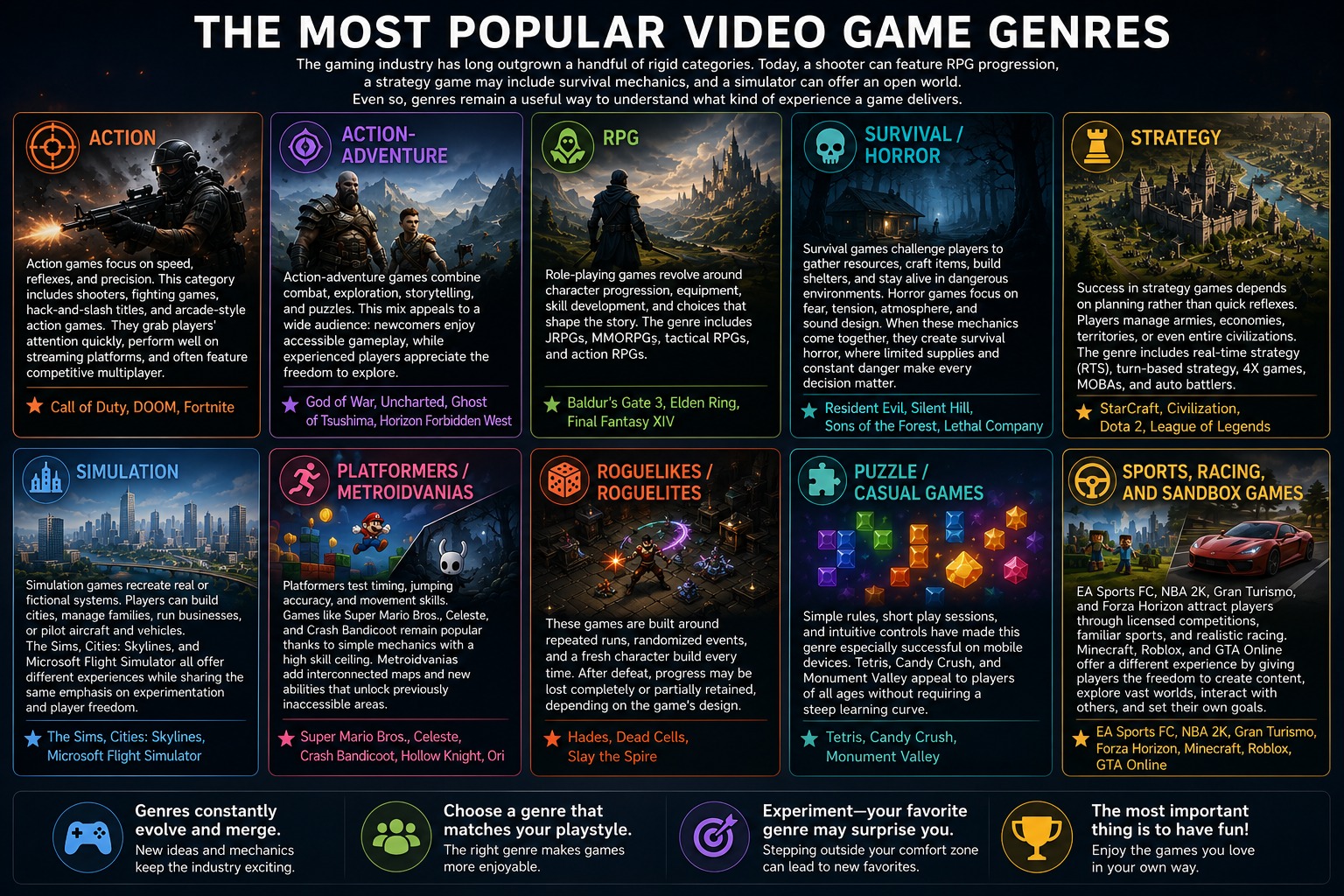
The gaming industry has long outgrown a handful of rigid categories. Today, a shooter can feature RPG progression, a strategy game may include survival mechanics, and a simulator can offer an open world. Even so, genres remain a useful way to understand what kind of experience a game delivers.
Action
Action games focus on speed, reflexes, and precision. This category includes shooters, fighting games, hack-and-slash titles, and arcade-style action games. They grab players’ attention quickly, perform well on streaming platforms, and often feature competitive multiplayer. Popular examples include Call of Duty, DOOM, and Fortnite.
Action-adventure
Action-adventure games combine combat, exploration, storytelling, and puzzles. This mix appeals to a wide audience: newcomers enjoy accessible gameplay, while experienced players appreciate the freedom to explore. Well-known titles include God of War, Uncharted, Ghost of Tsushima, and Horizon Forbidden West.
RPG
Role-playing games revolve around character progression, equipment, skill development, and choices that shape the story. The genre includes JRPGs, MMORPGs, tactical RPGs, and action RPGs. Games such as Baldur’s Gate 3, Elden Ring, and Final Fantasy XIV demonstrate just how diverse RPGs can be.
Survival / horror
Survival games challenge players to gather resources, craft items, build shelters, and stay alive in dangerous environments. Horror games focus on fear, tension, atmosphere, and sound design.
When these mechanics come together, they create survival horror, where limited supplies and constant danger make every decision matter. Resident Evil, Silent Hill, Sons of the Forest, and Lethal Company are excellent examples.
Strategy
Success in strategy games depends on planning rather than quick reflexes. Players manage armies, economies, territories, or even entire civilizations.
The genre includes real-time strategy (RTS), turn-based strategy, 4X games, MOBAs, and auto battlers. Franchises like StarCraft, Civilization, Dota 2, and League of Legends have maintained dedicated communities for many years.
Simulation
Simulation games recreate real or fictional systems. Players can build cities, manage families, run businesses, or pilot aircraft and vehicles.
The Sims, Cities: Skylines, and Microsoft Flight Simulator all offer different experiences while sharing the same emphasis on experimentation and player freedom.
Platformers / metroidvanias
Platformers test timing, jumping accuracy, and movement skills. Games like Super Mario Bros., Celeste, and Crash Bandicoot remain popular thanks to simple mechanics with a high skill ceiling.
Metroidvanias expand on this formula by introducing interconnected maps and new abilities that unlock previously inaccessible areas. Hollow Knight and Ori are among the best-known examples.
Roguelikes / roguelites
These games are built around repeated runs, randomized events, and a fresh character build every time. After defeat, progress may be lost completely or partially retained, depending on the game’s design.
Titles such as Hades, Dead Cells, and Slay the Spire turn failure into an opportunity to experiment with new strategies.
Puzzle / casual games
Simple rules, short play sessions, and intuitive controls have made this genre especially successful on mobile devices. Tetris, Candy Crush, and Monument Valley appeal to players of all ages without requiring a steep learning curve.
Sports, racing, and sandbox games
EA Sports FC, NBA 2K, Gran Turismo, and Forza Horizon attract players through licensed competitions, familiar sports, and realistic racing.
Minecraft, Roblox, and GTA Online offer a different experience by giving players the freedom to create content, explore vast worlds, interact with others, and set their own goals.
Why genre boundaries are blurring
Most modern hit games combine mechanics from several genres. Developers often start with a familiar foundation and then add progression systems, building mechanics, co-op gameplay, procedural generation, or open-world exploration.
As a result, choosing a game based only on its genre is no longer enough. It’s also worth considering its gameplay mechanics, pacing, atmosphere, and overall style of play.